

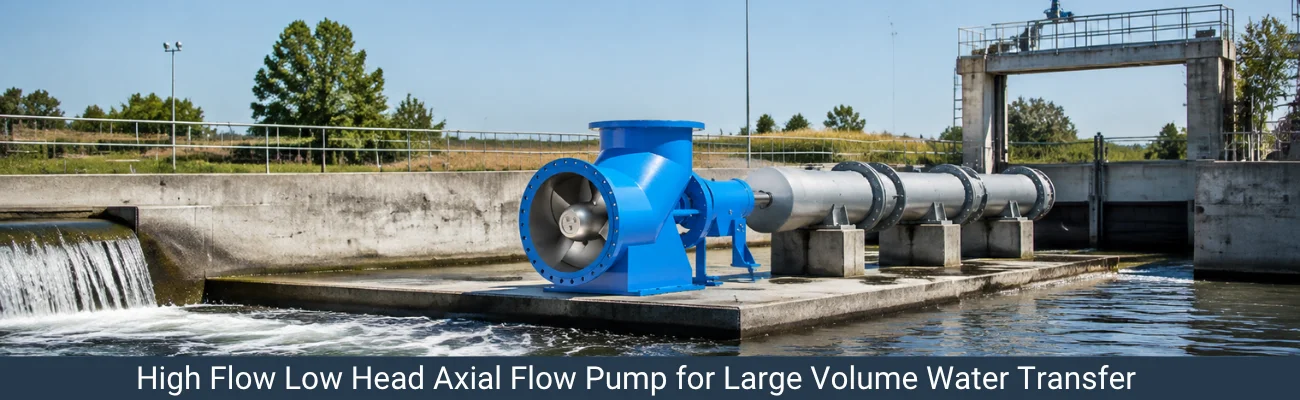
High Flow Low Head Axial Flow Pump: Working, Applications and Selection Guide
Some pumping applications need to move very large volumes of liquid over a short vertical lift, a combination that standard centrifugal pumps are not built to handle efficiently. A high flow low head axial flow pump is designed specifically for this requirement. This guide explains how these pumps work, where they are used, and how to select the right unit for your flow and head requirements.
What Is a High Flow Low Head Axial Flow Pump?
A high flow low head axial flow pump moves liquid parallel to the pump shaft using a propeller style impeller, generating large volumetric flow at relatively low discharge pressure. Unlike centrifugal pumps, which build head by accelerating fluid radially outward, axial flow pumps push fluid along the axis of rotation, making them highly efficient for applications that need volume rather than pressure.
Understanding High Flow and Low Head Pumping Requirements
High flow refers to a large volume of liquid moved per unit time, often measured in cubic meters per hour or liters per second. Low head refers to a small vertical lift or system resistance, typically under 10 to 15 meters. Applications combining these two characteristics, such as moving large volumes of water across a short elevation change, are poorly matched to centrifugal pumps, which are optimized for higher head and comparatively lower flow.
How Does an Axial Flow Pump Handle High Flow at Low Head?
The propeller shaped impeller in an axial flow pump accelerates fluid in a straight line along the pump axis rather than radially. This geometry allows the pump to move a very large volume of fluid with each impeller rotation while requiring relatively little pressure rise to achieve that flow, making axial flow pumps inherently efficient at low head, high volume duty points.
Key Design Features of High Flow Low Head Axial Flow Pumps
- Propeller style impeller with two, three, or four blades depending on flow and head requirements.
- Large diameter discharge to accommodate high volumetric flow with minimal pressure drop.
- Vertical or horizontal shaft configuration depending on installation constraints.
- Wide operating clearance between impeller and casing to reduce mechanical wear at high flow velocities.
- Corrosion resistant or non metallic construction options for aggressive or seawater applications.
Axial Flow Pump vs Centrifugal Pump for High Flow Low Head Applications
| Parameter | Axial Flow Pump | Centrifugal Pump |
|---|---|---|
| Flow characteristic | High volume, low head | Moderate volume, moderate to high head |
| Impeller design | Propeller, axial flow | Radial or mixed flow impeller |
| Efficiency at low head | High | Lower, often oversized for the duty |
| Typical applications | Flood control, irrigation, water transfer | General process and chemical transfer |
| Installation orientation | Vertical or horizontal | Typically horizontal or vertical inline |
How Flow Rate and Head Affect Axial Flow Pump Selection
Selecting an axial flow pump starts with plotting the required flow rate and head on the pump’s performance curve to confirm the unit operates near its best efficiency point. Operating far from this point, either at excessively high or low flow relative to the pump’s design curve, reduces efficiency and can increase the risk of cavitation or vibration over time.
Typical Applications of High Flow Low Head Pumps
Water Transfer
Axial flow pumps move large volumes of raw or process water between reservoirs, canals, and treatment facilities where elevation change is minimal.
Irrigation
Agricultural irrigation systems use axial flow pumps to move water from rivers, canals, or reservoirs into distribution channels across large land areas.
Flood Control
Flood control and stormwater pumping stations rely on axial flow pumps to move very high volumes of water quickly during heavy rainfall events, often with head requirements under 5 meters.
Cooling Water Circulation
Power plants and industrial facilities use axial flow pumps to circulate large volumes of cooling water through condensers and heat exchangers where the head requirement is limited to overcoming pipe friction losses.
Wastewater Treatment
Axial flow pumps are used in wastewater treatment for internal recirculation, such as moving mixed liquor between treatment basins, where high volume transfer at low head is required.
Industrial Process Fluid Transfer
Various industrial processes use axial flow pumps for transferring large volumes of process fluid within a plant, particularly where the transfer distance and elevation change are both limited.
Vertical vs Horizontal Configuration for High Flow Applications
Vertical axial flow pumps are typically installed in a sump or wet well, submerging the impeller directly in the fluid source, which is common in flood control and water transfer stations. Horizontal axial flow pumps are used where the installation layout favors inline piping configuration, such as cooling water circulation systems within a plant. The choice between orientations depends primarily on available space, suction conditions, and maintenance access requirements.
How to Select the Right Axial Flow Pump for Required Flow and Head
- Determine the required flow rate and total head based on system piping and elevation.
- Review the pump performance curve to confirm the operating point falls near the best efficiency range.
- Select the impeller blade configuration, since more blades typically increase head capability at the expense of some flow efficiency.

- Choose vertical or horizontal orientation based on installation space and suction requirements.
- Confirm the required motor power based on the flow, head, and pump efficiency at the design point.
- Verify compliance with applicable hydraulic standards, such as those referenced by the Hydraulic Institute in the United States, for performance testing and acceptance criteria.
Material Selection for Corrosive and Abrasive Fluids
Axial flow pumps handling seawater, chemically aggressive fluids, or abrasive slurries require careful material selection. Stainless steel 316 offers strong general corrosion resistance for moderately aggressive fluids, while duplex steel or Alloy 20 construction is used for more demanding chemical service. FRP or non metallic construction provides an alternative for highly corrosive applications where metallic wetted parts would degrade quickly, offering a lighter weight and corrosion free option for chemical transfer and marine service.
Energy Efficiency Considerations in High Volume Pumping
Because axial flow pumps move large volumes of fluid, even small efficiency losses translate into significant energy costs over continuous operation. Selecting a pump that operates near its best efficiency point, along with regular maintenance to prevent impeller wear or clearance changes, has a meaningful impact on total energy consumption, particularly in continuous duty applications like cooling water circulation and irrigation.
Common Problems in High Flow Low Head Pumping Systems
- Cavitation caused by insufficient net positive suction head available at the pump inlet.
- Reduced efficiency from operating away from the pump’s best efficiency point on the performance curve.
- Vibration resulting from impeller imbalance, wear, or misalignment in vertical installations.
- Increased power draw due to impeller clearance wear over extended service life.
- Air entrainment in open sump installations, reducing flow stability and pump performance.
Axial Flow Pump Operating Parameters to Consider
- Flow rate, typically expressed in cubic meters per hour or liters per second.
- Total dynamic head, including static lift and friction losses through the piping system.
- Net positive suction head available versus required, to prevent cavitation.
- Motor power and speed, matched to the pump’s performance curve at the design operating point.
- Fluid properties, including specific gravity, viscosity, and solids content, which affect pump sizing and material selection.
 Call Us Now !
When Should You Choose an Axial Flow Pump Instead of Another Pump Type?
An axial flow pump is the right choice when the application requires very high volumetric flow at low head, such as flood control, irrigation, or large scale water transfer. Where the application instead requires higher head with moderate flow, a centrifugal or mixed flow pump is typically a more efficient and appropriate choice, since axial flow pumps lose efficiency rapidly as head requirements increase beyond their design range.
High Flow Low Head Axial Flow Pump Selection Checklist
- Confirmed required flow rate and total head for the application.
- Verified the operating point falls near the pump’s best efficiency range.
- Selected vertical or horizontal configuration based on installation constraints.
- Chosen material of construction based on fluid corrosivity and abrasiveness.
- Confirmed available net positive suction head exceeds the pump’s requirement.
- Reviewed motor power sizing against the pump’s performance curve.
Why Choose Propeller Pumps for High Flow, Low Head Applications?
Selecting the right high flow low head axial flow pump requires matching flow rate, head, material construction, and installation configuration precisely to the application, whether it is water transfer, irrigation, flood control, or industrial process fluid movement. Working with an experienced axial flow pump manufacturer ensures the pump curve, materials, and orientation are engineered for the specific duty point, delivering reliable, energy efficient performance across the full range of high volume, low head pumping applications.
