

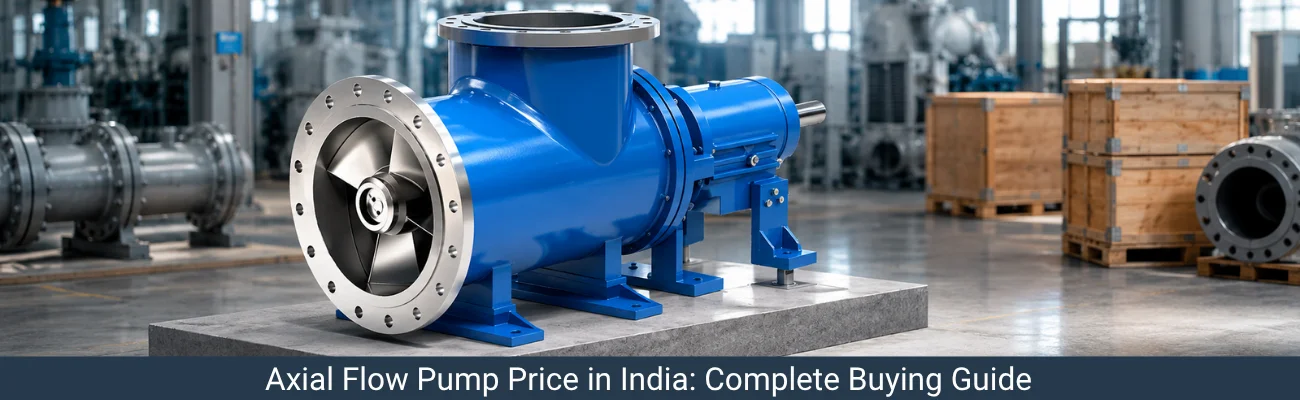
Axial Flow Pump Price in India-Cost Factors, Types and Buying Guide
Understanding what drives axial flow pump pricing helps buyers evaluate quotations accurately and avoid comparing incomplete offers. Price varies significantly based on flow rate, head, material of construction, and automation level. This guide breaks down the major cost factors and offers a practical framework for buying an axial flow pump in India.
How Much Does an Axial Flow Pump Cost in India?
Axial flow pump prices in India vary widely depending on size, capacity, and material construction, ranging from smaller units suited to irrigation or water transfer duty to large custom engineered pumps for flood control or industrial cooling water systems. Because these pumps are typically built to order based on specific flow and head requirements, an accurate price can only be determined after reviewing the application details rather than from a fixed price list.
What Determines the Price of an Axial Flow Pump?
- Required flow rate and head, which determine impeller size, casing dimensions, and motor power.
- Material of construction, since corrosion resistant alloys and non metallic materials cost more than standard carbon steel.
- Orientation, vertical or horizontal, which affects mounting hardware and installation complexity.
- Automation level, from a basic manually started unit to a fully automated system with instrumentation and control integration.
- Customization requirements, including special coatings, seal arrangements, or non standard flange configurations.
- Motor specification, including efficiency class, voltage, and enclosure rating suited to the installation environment.
Axial Flow Pump Price Based on Flow Rate and Head
As required flow rate and head increase, pump size, motor power, and material volume all increase proportionally, directly raising the overall cost. A small axial flow pump designed for a modest irrigation channel will cost considerably less than a large unit engineered for a flood control pumping station moving thousands of cubic meters per hour, since the larger unit requires a bigger impeller, casing, motor, and supporting structure.
How Pump Size Affects Axial Flow Pump Cost
Pump size is typically expressed by discharge diameter and impeller diameter, both of which scale with the required flow rate. Larger pumps require more raw material, heavier duty bearings and shafts, and larger motors, all of which increase manufacturing cost. Buyers should avoid oversizing a pump beyond actual requirements, since unnecessary capacity adds cost without operational benefit.
Vertical vs Horizontal Axial Flow Pump: Price Considerations
Vertical axial flow pumps, commonly installed in sumps or wet wells, often require less extensive foundation work but may need a longer shaft assembly depending on installation depth, affecting overall cost. Horizontal axial flow pumps typically require a more substantial foundation and alignment setup but can simplify maintenance access. The price difference between the two configurations depends largely on the specific installation requirements rather than a fixed cost differential between orientations.
How Material of Construction Affects Pump Price
Stainless Steel 304
A moderate cost upgrade offering good general corrosion resistance, suitable for mildly corrosive water and process fluids.
Stainless Steel 316
A higher cost option providing improved resistance to chlorides and more aggressive corrosive conditions compared to 304 grade stainless steel.
Duplex Steel / CD4MCu
A premium material choice offering high strength and superior corrosion resistance for demanding chemical or seawater applications, priced above standard stainless steel grades.
Alloy 20
Used for highly corrosive chemical service, particularly with sulfuric acid, Alloy 20 construction carries a significant cost premium due to the specialized alloy content.
FRP / Non Metallic Construction
Fiber reinforced plastic construction offers strong corrosion resistance at a competitive price point compared to premium metal alloys, making it a cost effective option for many corrosive fluid applications, though selection should be based on chemical compatibility and operating temperature.
Manual vs Automated Axial Flow Pump Systems: Cost Considerations
A manually operated axial flow pump with basic start and stop control carries the lowest initial cost. Adding automation, such as level sensors, automatic start and stop logic, remote monitoring, or integration with a plant control system, increases upfront investment but can reduce labor costs and improve reliability over the system’s operating life, particularly in flood control and continuous process applications.
FRP Axial Flow Pump vs Metallic Axial Flow Pump: Cost and Application
| Parameter | FRP Axial Flow Pump | Metallic Axial Flow Pump |
|---|---|---|
| Corrosion resistance | Excellent for most chemical and seawater duty | Depends on alloy selected |
| Weight | Lighter | Heavier |
| Typical cost | Competitive for corrosive service | Varies widely by alloy grade |
| Application fit | Chemical transfer, seawater, corrosive fluids | General water transfer, high strength requirements |
| Temperature limitations | Limited compared to metals | Higher temperature tolerance |
What Is Included in an Axial Flow Pump Quotation?
A complete axial flow pump quotation should specify the pump model, rated flow and head, impeller material and blade configuration, casing material, motor specification, shaft and bearing details, and any included accessories such as base frames or coupling guards. Buyers should confirm whether installation, commissioning, and freight are included or quoted separately, since these can represent a meaningful portion of total project cost.
How Customization Affects Axial Flow Pump Price
Standard catalog configurations are generally more cost effective than fully customized pumps, since custom engineering, non standard materials, or unique flange patterns require additional design and manufacturing effort. Buyers with flexible requirements can often reduce cost by selecting close to standard configurations rather than requesting extensive customization.
 Call Us Now !
Installation, Motor and Accessories: Additional Cost Factors
Beyond the pump itself, total project cost includes the motor, which may be quoted separately depending on required efficiency class and voltage, along with base frames, coupling guards, control panels, and any variable frequency drives if speed control is required. Installation labor, foundation work, and commissioning services add further cost that should be accounted for when budgeting for a complete pumping system.
Axial Flow Pump Manufacturer vs Supplier: What Should Buyers Consider?
A manufacturer designs and produces the pump directly, offering greater control over customization, quality, and after sales support, while a supplier or trader typically resells pumps produced by others, which can limit customization options and complicate warranty or spare parts support. Buyers seeking a pump matched precisely to specific flow, head, and material requirements generally benefit from working directly with an axial flow pump manufacturer rather than an intermediary supplier.
How to Choose a Reliable Axial Flow Pump Manufacturer in India
- Verify the manufacturer’s in house design and engineering capability for custom flow and head requirements.
- Review available material options, including stainless steel, duplex, Alloy 20, and FRP construction.
- Confirm manufacturing quality practices and any relevant certifications for pump testing and performance verification.
- Ask for references or case studies from similar applications, such as irrigation, flood control, or chemical processing.
- Evaluate after sales support, including spare parts availability and technical assistance for installation and commissioning.
Why Manufacturing Capability Matters When Buying an Axial Flow Pump
A manufacturer with strong in house fabrication and testing capability can offer more accurate performance curves, better quality control, and faster turnaround on custom requirements compared to a reseller sourcing from multiple third party sources. This is particularly important for axial flow pumps, since flow and head requirements vary significantly by application and often call for engineered rather than purely catalog solutions.
Questions to Ask an Axial Flow Pump Supplier Before Ordering
- What is the guaranteed performance curve for the specified flow and head, and how was it verified?
- What material of construction is recommended for the specific fluid and application?
- What is the expected lead time for manufacturing and delivery?

- Are spare parts and technical support available locally in India?
- Does the quotation include installation, commissioning, and any required accessories?
Axial Flow Pump Buying Checklist for Industrial Projects
- Confirmed required flow rate and total head for the application.
- Selected material of construction based on fluid corrosivity and temperature.
- Decided on vertical or horizontal orientation based on installation layout.
- Reviewed automation requirements and associated cost implications.
- Requested a detailed quotation covering pump, motor, accessories, and installation scope.
- Verified manufacturer credentials, references, and after sales support availability.
How to Request an Accurate Axial Flow Pump Price/Quotation
To receive an accurate axial flow pump price quotation, buyers should provide the required flow rate, total head, fluid properties including temperature and any corrosive or abrasive characteristics, preferred orientation, and any automation requirements. Sharing this information upfront with an axial flow pump manufacturer in India allows for a precise, application matched quotation rather than a generic estimate, helping avoid cost surprises later in the project.
