
A knife gate valve replacement is easiest when the existing installation and the proposed valve drawing are compared before the order is released. Checking knife gate valve dimensions involves comparing the installation length, flange connection and space required for operation and maintenance.
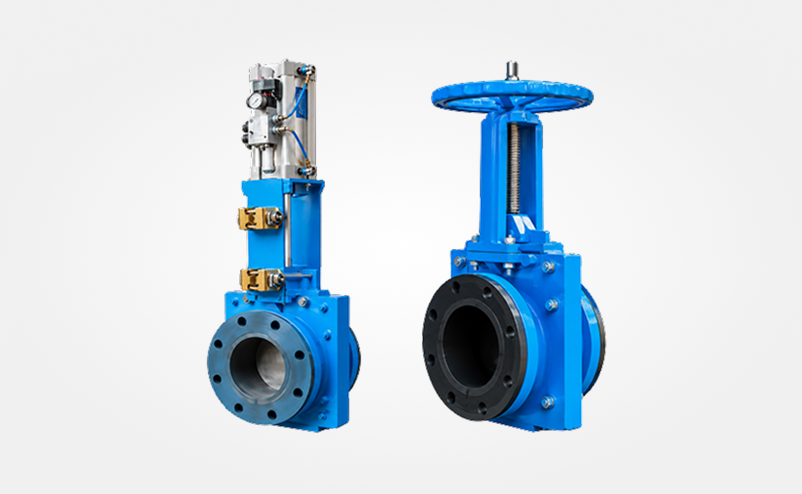
Propeller Pumps manufactures the knife gate valve in unidirectional and bidirectional designs, with manual, chain wheel, pneumatic, electric and hydraulic operation. These valves serve media containing suspended solids, fibrous particles, pulp or slurry, so accurate service and installation details matter when ordering a replacement.
This guide sets out what maintenance planners, shutdown teams and buyers should record, compare and confirm.
Knife Gate Valve Replacement: Record the Existing Valve First
Begin with what is actually installed. Collect:
- Photographs of the valve tag and nameplate
- Manufacturer, model and nominal size, where available
- Existing drawings and previous purchase specifications
- Body, gate and seal information, if documented
- Operating method and actuator identification
- Flow direction markings
- Process medium, operating pressure and temperature
- The reason for replacement
Mark each entry as verified or unknown. Verified means taken from a nameplate, drawing or purchase record. An honest “unknown” gives the supplier a clear question to resolve, while a specification guessed from the valve’s appearance does not.
The reason for replacement shows whether the new valve should match the old one or change something, such as material or operating method.
Record materials carefully. Propeller Pumps offers bodies in cast iron, ductile iron, carbon steel, stainless steel and plastic, selected to suit chemical compatibility, pressure and temperature. Request confirmation of the body, gate, seat and seal materials, and note the line duty, such as mining, wastewater treatment, pulp and paper, power generation, food processing or chemical processing.
Valve Face to Face Dimensions: Compare Before Ordering
The face-to-face dimension is the distance between the two connecting faces of the valve. It is the length of pipeline the valve occupies.
Compare the documented existing figure with the dimension on the proposed drawing, and check that both are measured between the same reference points. If the existing value comes from a site measurement, note where it was taken and whether gaskets were in place.
Ask the supplier to state what the drawing dimension includes, particularly regarding gaskets and the flange arrangement. Do not assume every drawing is measured the same way.
Nominal size is not a reliable guide to valve face to face dimensions. Any difference should be resolved on paper before the shutdown.
Valve Flange Compatibility: Drilling and Connection Checks
Valve flange compatibility concerns how the replacement connects to the existing pipe flanges. Compare or confirm:
- Flange designation and pressure class
- Number of bolt holes
- Bolt circle diameter
- Hole diameter, or threaded connection details where applicable
- Flange facing and gasket arrangement
- Fastener access and proposed fastening details
Propeller Pumps lists flange drilling to ASME B16.5 / ASME B16.47 #150 and BS EN 1092 PN 10 / PN 16. Treat the designation as a reference only, and check the actual drilling, facing and fastener details on the proposed drawing against the existing flanges.
Keep drilling and pressure as separate questions, because a matching bolt pattern does not show that the valve suits the service. The published pressure ratings are PN3, PN6 and PN10, depending on housing material, so confirm which one applies to the valve proposed.
Knife Gate Valve Bore Alignment Checks
The bore is the internal opening through which the medium passes, and this check is separate from the bolt pattern. The company’s knife gate valves have a full bore opening, so request the bore dimension on the proposed drawing for comparison with the adjoining pipework.
Gather the bore dimensions of the existing valve and connecting pipework, plus details of any nearby reducers, liners, gaskets or lined spools. Where internal dimensions are unavailable, list them as open items in the checklist.
Knife Gate Valve Dimensions for Actuator Clearance and Access
The complete assembly needs space beyond the valve body. Compare the overall dimensions on the proposed drawing with nearby structures, pipework, platforms and equipment. Check:
- Overall dimensions in the relevant operating positions
- Gate and stem movement, as shown on the drawing for that design
- Handwheel or chain wheel access
- Space for a pneumatic, electric or hydraulic actuator
- Access for connections and maintenance
Each operating method produces a different assembly. Request a separate drawing for every option under consideration, rather than assuming a change from a manual to a pneumatic knife gate valve leaves the dimensions unchanged.
Mounting Orientation for Unidirectional and Bidirectional Knife Gate Valves
The installed position must suit the valve design and the surrounding structure. Document:
- Pipeline orientation
- Existing valve and actuator position
- Direction of flow and pressure in service
- Nearby pipe supports and mounting provisions
- Any proposed change in operating method or assembly size
A unidirectional knife gate valve from Propeller Pumps seals against pressure from one side. The bidirectional version uses a double seated design for shutoff from either side, so record any reverse flow or downstream pressure before the design is chosen.
Ask the supplier and your responsible engineer to confirm the proposed orientation and whether the existing supports remain suitable.
Knife Gate Valve Replacement Checklist
| Review Item | Existing Installation Record | Proposed Replacement Confirmation |
|---|---|---|
| Valve identification and nominal size | Nameplate, tag, records | Model and size on drawing |
| Face to face dimension | Documented value and reference points | Drawing value and what it includes |
| Flange drilling and facing | Designation, bolt pattern, facing | Drilling and facing on drawing |
| Bore and adjacent connections | Bore, liners, reducers, gaskets | Valve bore on drawing |
| Overall dimensions and operating envelope | Available space at site | Envelope in operating positions |
| Actuator and maintenance access | Existing operator and access route | Proposed actuator and access |
| Mounting and flow orientation | Line orientation, flow markings | Design type and position |
| Pipe supports | Existing supports and provisions | Engineer confirmed arrangement |
| Service conditions and materials | Medium, pressure, temperature | Body, gate, seat, seal, pressure rating |
| Drawing revision and open differences | Open questions | Revision number and resolution |
Your responsible team should review the proposed drawing against this record, clarify differences with the supplier and record acceptance, including the drawing revision, before releasing the purchase order.
Preparing a Knife Gate Valve Enquiry
The published Propeller Pumps range covers DN 50 to DN 1200, with a minimum order quantity of one piece. Confirm that your required combination of size, material, pressure rating and actuation is available.
When comparing knife gate valve suppliers, request a drawing for the exact size, material and operating arrangement being offered.
Share the completed checklist and ask for confirmation of the offered configuration and any unresolved differences.
About Propeller Pumps, Knife Gate Valve Manufacturer in India
Propeller Pumps is a Gujarat based manufacturer and exporter of industrial pumps, knife gate valves and mixing equipment, established in 2008. Its range covers axial flow, mixed flow, centrifugal, chemical process, polypropylene, FRP and non metallic axial flow pumps, feed and process pumps, pump accessories, high flow and submersible agitators, and solid liquid separator machines. Knife gate valves are manufactured at its Ahmedabad facility and exported to markets including the UAE, Saudi Arabia, Kenya and Russia, with shipments packed to international cargo standards.
Discuss Your Knife Gate Valve Replacement With Propeller Pumps
Documented comparison helps identify fit differences before ordering. Share your existing valve details, measurements, service requirements and drawings with Propeller Pumps, and review the knife gate valve range for published designs and operating options.