
Water supply, cooling, and process projects often reach a point where the team must choose between an End Suction Pump and a split case pump. Both are horizontal centrifugal pump constructions, yet they differ in how liquid enters, how the casing opens, and where the pipework connects.
This guide approaches the end suction pump vs split case pump question in three steps: defining the duty, checking how the pump fits and is serviced on site, and comparing supplier data on equal terms. The right construction depends on the duty, site layout, and maintenance practice of each project, so neither is treated as the default.
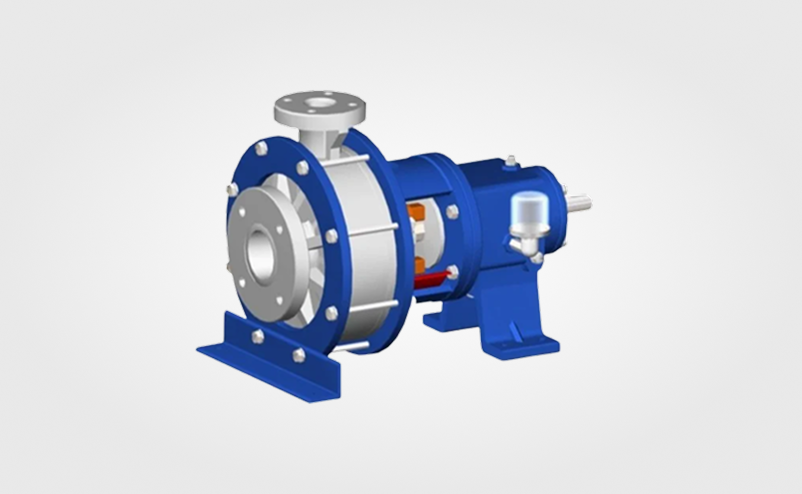
Propeller Pumps manufactures an end suction centrifugal pump range in back pull out construction.
End Suction Pump and Split Case Pump Construction Differences
In an end suction centrifugal pump, liquid enters along the shaft axis through a nozzle at the front of the casing and flows into the eye of the impeller. Propeller Pumps offers its range with top centreline discharge, meaning the outlet points vertically upward from the centre line of the casing.
The impeller is mounted at the end of the shaft, overhung beyond the bearings, which sit in a bearing frame on the drive side. The published design is horizontal, foot mounted, and single stage.
Back pull out construction means the rotating assembly, made up of the impeller, shaft, bearings, seal, and back plate, can be withdrawn from the rear as one unit. The casing stays bolted to the suction and discharge pipework.
A split case pump has a casing divided into two halves, usually along a plane through the shaft centre line, with the halves bolted together. Suction and discharge nozzles are commonly placed on the sides of the casing.
In many split case designs, incoming liquid is divided so it reaches the impeller from both sides. The shaft is typically carried by a bearing at each end, with the impeller between them.
Defining the Duty for Industrial Water Pump Selection
The duty is the first filter, because it decides which constructions reach the shortlist at all. Record the following before approaching suppliers:
- Required flow and head at the design point
- The full range of operating points the system will produce
- Number of pumps running together, plus standby units
- Liquid type, temperature, and any suspended solids
- Planned capacity changes over the life of the plant
The spread of operating points deserves as much attention as the design point. A municipal water pump station may see demand rise and fall through the day, while a water circulation pump in a process plant may hold close to one condition.
Parallel operation and standby arrangements change how each unit is sized. Future capacity can be met by adding units, changing impellers, or choosing larger pumps now, and each route affects which construction suits the plant.
No general flow or head figure decides between the two designs, so share the full operating range, not only the design point, with every supplier.
Installation Footprint of a Horizontal Centrifugal Pump
Footprint concerns floor space only; pipe connections are reviewed separately. Check:
- Available floor area in the pump house or plant room
- Baseplate and foundation space for the pump, coupling, and motor
- Number of units, including standby
- Clearance around each set for operation and access
- Lifting provisions such as hoists, cranes, or beams
Clearance is not uniform around a pump set. Keep space free where parts will come out, which is behind a back pull out unit and above the casing of a split case unit.
Lifting provisions should be rated for the heaviest item the team will handle, whether a rotating assembly, a casing half, or a motor.
Compare footprint using general arrangement (GA) drawings laid out at the full number of units. Request GA drawings for any shortlisted Propeller Pumps model so the layout reflects actual dimensions.
Maintenance Planning for a Back Pull Out Centrifugal Pump
Servicing over the working life of the pump depends on:
- Components expected to need routine attention, such as seals and bearings
- Whether piping or the motor must be disturbed to reach internal parts
- Skills and tools within the maintenance team
- Spare parts and standardisation with pumps already in service
- Acceptable downtime, and whether standby units cover it
For a back pull out centrifugal pump, the practical question is what else must move during assembly withdrawal. Ask Propeller Pumps whether the motor stays in place, since this depends on the coupling and baseplate arrangement offered.
For a split case pump, confirm which connections, fasteners, and seals must be released before the upper casing half comes off.
Piping Arrangement for an End Suction Centrifugal Pump
Piping review covers how the pump connects to the system. Check:
- Connection orientation required by each construction
- Existing or planned pipe routing
- Space for valves, strainers, and fittings near the pump
- Pipe supports, and how loads reach the pump connections
- Whether the project is a new build or a retrofit
Because suction and discharge sit on different axes, end suction pipework usually turns at the pump. Plan valve and fitting space on both lines. Side nozzles on a split case pump place the connections differently, which suits some routes and complicates others.
Propeller Pumps also offers a centrifugal pump with flanged suction and discharge for flanged piping systems. Confirm flange details early so the pipework matches the pump connections.
Pipe supports should keep piping weight off the pump connections, and each supplier should state allowable connection loads. In retrofits, fixed pipe centres or valve positions may narrow the shortlist before hydraulics are compared.
Comparing Offers From Industrial Pump Manufacturers in India
When offers arrive from several industrial pump manufacturers in India or abroad, request and check:
- Performance curve covering the duty and operating range
- Rated operating point marked on the curve
- Materials of construction for wetted parts
- GA and dimensional drawing
- Motor details, where a complete unit is offered
- Inspection or test documents available with supply
Evaluate every offer against the same duty. Ask each supplier to state the assumptions behind its data sheet, including liquid properties, speed, impeller size, and scope of supply.
Scope can differ widely. Propeller Pumps offers centrifugal bare pumps, supplied as pump ends without a driver for use with a customer specified motor or drive. When such an offer is compared with a complete pump and motor set, add the motor and baseplate separately.
Wetted materials need equal care. The Propeller Pumps range includes cast iron, cast steel, stainless steel grades such as SS304 and SS316, and alloys such as Alloy 20 and Hastelloy. The right grade is confirmed against the actual liquid and temperature.
End Suction Pump and Split Case Pump Comparison Table
Use this table as a checklist when preparing the review. It records points to check, not rankings.
| Selection Factor | End Suction Pump: Points to Review | Split Case Pump: Points to Review |
|---|---|---|
| Construction | Axial suction, top centreline discharge, overhung impeller | Two casing halves, side nozzles, impeller between bearings |
| Flow and head requirement | Duty checked against the published end suction range | Duty checked against the split case supplier curve |
| Installation footprint | Rear withdrawal space on GA drawing | Casing lift space on GA drawing |
| Maintenance approach | Motor movement during assembly withdrawal | Connections to release before casing lift |
| Piping arrangement | Turn in pipework at the pump, flange details | Side nozzle positions against planned routing |
| Supplier data to request | Curve, wetted materials, GA drawing, bare pump or complete set | Curve, wetted materials, GA drawing, scope of supply |
The Propeller Pumps end suction range serves water supply and distribution, fire fighting, effluent treatment, and cooling tower systems, where cooling water pump duties are common.
If the review instead points toward split case construction for the project’s flow, layout, or maintenance practice, that is a valid outcome of a sound selection.
About Propeller Pumps, Centrifugal Pump Manufacturer in India
Propeller Pumps is an Ahmedabad, Gujarat based manufacturer established in 2008, supplying industrial pumps in India and to export markets. Its range covers centrifugal, axial flow, mixed flow, chemical process, polypropylene, FRP and non metallic pumps, along with feed pumps, knife gate valves, agitators, submersible mixers, solid liquid separators, and pump accessories. For project teams, this means end suction options and related process equipment for the same plant can come from one manufacturer.
Send Your End Suction Pump Enquiry to Propeller Pumps
Share your duty requirements, site layout, piping drawings, and maintenance preferences with Propeller Pumps. The team can then assess whether a configuration and material from its centrifugal pump range suits your project.