
Plot No. B-3&4 Nakshtra Industrial Hub, Next to Amba Hotel, Bridge, Indore
Highway, Village Chandial, Ta : Daskroi, Dist : Ahmedabad - 382433, Gujarat, India.
Mr. Kamal Panchal
+91-9904376492 Plot No. B-3&4 Nakshtra Industrial Hub, Next to Amba Hotel, Bridge, Indore
Highway, Village Chandial, Ta : Daskroi, Dist : Ahmedabad - 382433, Gujarat, India.
Mr. Kamal Panchal
+91-9904376492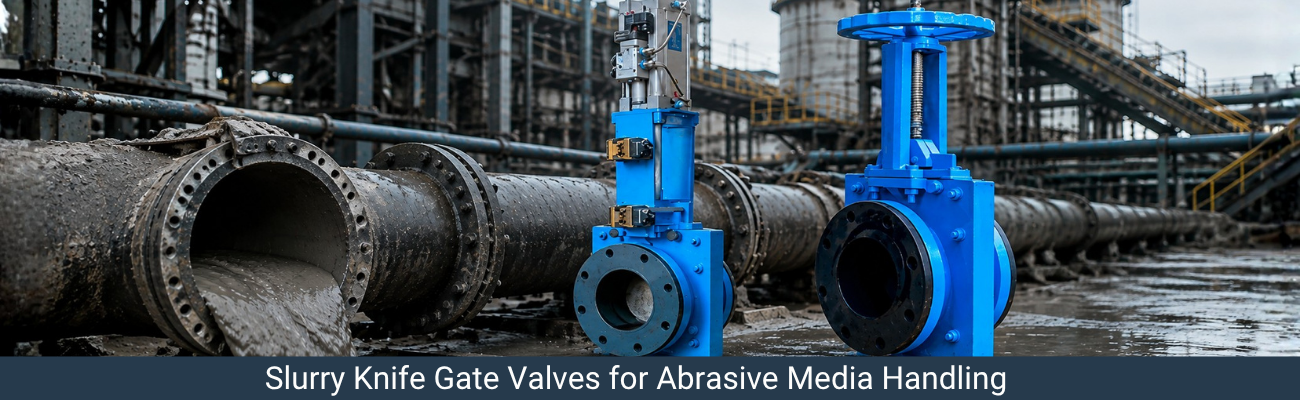
Slurry handling puts unique demands on isolation valves, since the media combines liquid flow with abrasive solid particles that can quickly wear out a poorly designed valve. A slurry knife gate valve is purpose built to withstand this environment while still delivering reliable shut off. This guide covers the design features, application areas, and selection criteria that matter most when specifying a slurry knife gate valve.
A slurry knife gate valve is a knife gate valve engineered specifically for services carrying a mixture of liquid and solid particles. It typically features a reinforced gate, an abrasion resistant seat, often rubber lined, and a body designed to minimize turbulence and settling that could accelerate wear at the seating surface.
Slurry is a suspension of solid particles in a liquid carrier, common in mining, mineral processing, power plant ash handling, and wastewater sludge systems. The abrasive nature of suspended solids causes accelerated wear on standard valve seats and gates, which is why slurry service requires valves built with hardened materials, reinforced seats, and geometry that minimizes particle impingement at the sealing surface.
 Email Us !
Abrasion resistance is the single most important performance factor for a slurry knife gate valve. Seat materials such as natural rubber, neoprene, or polyurethane are selected for their ability to absorb particle impact without rapid degradation. Gate surfaces are often hardened or coated to resist the cutting action of sharp mineral particles moving at velocity through the valve bore.
The knife edge of the gate is what allows the valve to cut cleanly through settled or suspended solids on every closure, preventing the jamming that would occur with a flat faced gate valve or ball valve in the same service. A sharp, well maintained gate edge is essential to consistent sealing performance and reduced actuator load over the life of the valve.

Rubber lined knife gate valves use a continuous rubber lining across the seat and internal body surfaces to absorb the impact of abrasive particles and extend service intervals. This construction is particularly common in tailings, dredging, and mineral concentrate lines where particle size and velocity would otherwise cause rapid wear on an unlined valve body.
For slurry lines with a single, consistent flow direction, such as pump discharge to a thickener or tailings pond, a unidirectional slurry knife gate valve provides a tighter, more cost effective seal. Where the slurry line includes recirculation or reverse flow during cleanout, backwashing, or maintenance cycles, a bidirectional design is the more reliable choice, since it maintains sealing performance regardless of flow orientation.
| Actuation Type | Best Suited For | Key Consideration |
|---|---|---|
| Manual | Infrequent isolation, non critical lines | Lowest cost, requires operator access |
| Pneumatic | Frequent cycling, standard slurry duty | Requires compressed air supply |
| Electric | Remote control, precise positioning | Requires stable electrical supply |
| Hydraulic | Large valves, high resistance slurry | Highest force output, needs power unit |
Mining operations use slurry knife gate valves throughout the process circuit, from crusher discharge and grinding mill feed to flotation, thickening, and tailings disposal lines. Rubber lined, unidirectional valves with pneumatic or hydraulic actuation are common in this sector due to the continuous, abrasive, high volume flow typical of mining slurries.
In mineral processing plants, slurry knife gate valves isolate individual process stages, allowing maintenance or cleaning without shutting down the entire circuit. Seat and gate material selection in this sector often depends on the specific ore type and particle hardness, since silica bearing slurries are considerably more abrasive than softer mineral suspensions.
Power plants use slurry knife gate valves in bottom ash and fly ash handling systems, where high temperature and abrasive particulate content demand hardened seat and gate materials. General industrial plants use similar valves in process slurry lines, scrubber circuits, and wastewater sludge systems, adapting body material and seat design to the specific chemical and abrasive characteristics of each application.
 Call Now !
A properly specified slurry knife gate valve, matched in seat material, gate hardness, and flow configuration to the actual process conditions, delivers longer service life and more reliable isolation than a generic valve selection, reducing both maintenance frequency and unplanned downtime across mining, mineral processing, and industrial slurry systems.