
Plot No. B-3&4 Nakshtra Industrial Hub, Next to Amba Hotel, Bridge, Indore
Highway, Village Chandial, Ta : Daskroi, Dist : Ahmedabad - 382433, Gujarat, India.
Mr. Kamal Panchal
+91-9904376492 Plot No. B-3&4 Nakshtra Industrial Hub, Next to Amba Hotel, Bridge, Indore
Highway, Village Chandial, Ta : Daskroi, Dist : Ahmedabad - 382433, Gujarat, India.
Mr. Kamal Panchal
+91-9904376492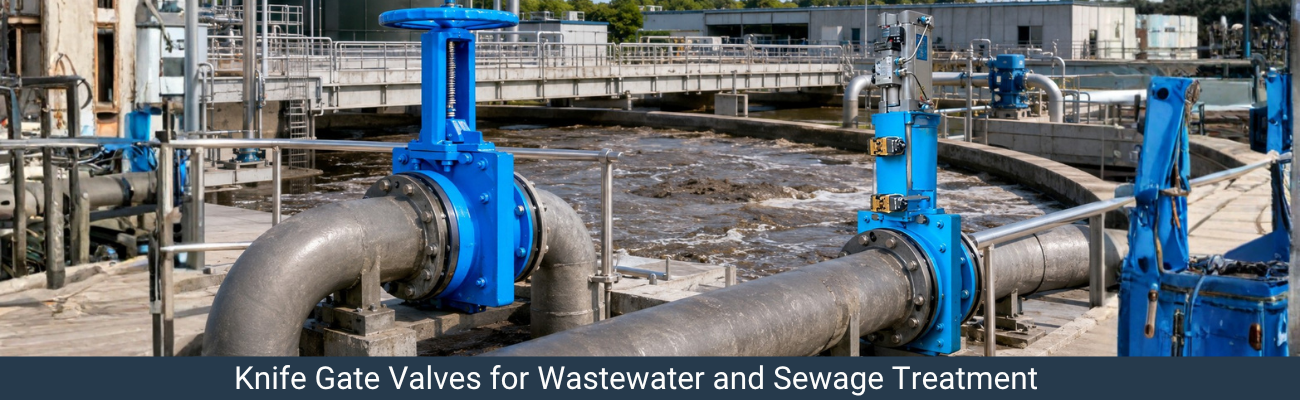
Wastewater and sewage systems carry a mix of suspended solids, fibrous material, and sludge that requires an isolation valve capable of shutting off cleanly without clogging or jamming. Knife gate valves are widely used across treatment plants for exactly this reason. This guide explains where and why knife gate valves are used in wastewater treatment and sewage applications, and how to select the right configuration for each stage of the process.
Knife gate valves offer a full bore, unobstructed flow path when open, along with a sharp gate edge that cuts through solids and fibrous debris rather than trapping them at the seat. This makes them far less prone to clogging than ball or globe valves in wastewater service, while their compact face to face dimensions simplify installation in the tight piping layouts common at treatment facilities.
In sewage handling, knife gate valves isolate lines carrying raw sewage, screenings, grit, and sludge at various points across a treatment plant. Their ability to close fully even with solids present in the line reduces the risk of incomplete shut off, a common failure mode for other valve types when handling sewage that contains rags, fibrous material, or grit.
Raw sewage lines carry the highest concentration of solids and debris, making knife gate valves a preferred choice for isolation at lift stations, screening channels, and influent lines. Ductile iron or cast iron bodies with resilient EPDM seats are commonly specified for this stage due to their durability and resistance to the biological and chemical conditions typical of raw sewage.
Sludge lines present a thicker, more viscous media than raw sewage, requiring valves capable of shearing through dense, semi solid material. Knife gate valves handle this duty effectively due to their sliding gate design, which displaces sludge away from the sealing surface as the gate closes, unlike valve types that rely on a rotating ball or disc.
In primary treatment, knife gate valves isolate lines around grit chambers, primary clarifiers, and screening equipment. In secondary treatment, they are used around aeration basins, secondary clarifiers, and return activated sludge lines, where consistent isolation is needed for maintenance and process control without disrupting the biological treatment process.
Sludge thickening and dewatering equipment, including belt presses, screw presses, and centrifuges, require reliable upstream and downstream isolation valves. Knife gate valves in this service are typically selected with wear resistant seats, since the sludge at this stage is often more concentrated and can contain grit that accelerates seat wear over time.

The combination of a full bore opening and a sharp shearing gate makes knife gate valves particularly effective at handling fibrous materials such as rags, hair, and other debris common in municipal sewage. Where other valve types would trap this material at the seat and prevent full closure, a knife gate valve cuts through it cleanly on every cycle.
Rubber lined knife gate valves provide additional protection in wastewater lines carrying abrasive grit alongside organic solids. The rubber lining absorbs particle impact across the body and seat, extending service life in high solids content applications such as grit removal systems and raw influent lines.
| Parameter | Stainless Steel | Cast Iron |
|---|---|---|
| Corrosion resistance | Excellent, suited to chemically aggressive streams | Good for general wastewater, less resistant to acidic conditions |
| Typical cost | Higher | Lower |
| Common application | Chemical dosing, corrosive effluent lines | General sewage and sludge isolation |
| Service life | Longer in harsh conditions | Adequate for standard municipal duty |
| Weight | Lighter for equivalent size | Heavier |
Manual knife gate valves remain common for infrequently operated isolation points, such as bypass lines or equipment maintenance valves, where cost efficiency outweighs the need for remote control. Automated valves, using pneumatic, electric, or hydraulic actuators, are specified at points requiring frequent cycling, remote operation from a control room, or integration with plant automation systems, such as sludge transfer and process control valves.
Pneumatic actuation is common throughout treatment plants where compressed air is already available for other equipment, offering fast cycle times for frequently operated valves such as those on sludge transfer lines. Electric actuation is often selected for valves requiring precise positioning or integration with SCADA systems, particularly at flow control points where partial gate positioning is needed rather than simple open and close operation.
Wastewater treatment involves both corrosive chemical exposure, from disinfection byproducts and acidic conditions in some sludge streams, and abrasive wear from grit and mineral particles. Valve specification should account for both factors, often requiring a combination of corrosion resistant body material and an abrasion resistant seat design to achieve acceptable service life across the plant.
 Call Now !
Proper installation requires correct flow direction alignment for unidirectional valves, adequate support for larger diameter valves to prevent flange stress, and accessible actuator positioning for maintenance. Routine maintenance should include periodic inspection of the seat and gate for wear, packing gland adjustment to prevent leakage, and verification of actuator response time, particularly for valves in critical isolation or emergency bypass service.
| Treatment Stage | Typical Media | Recommended Valve Configuration |
|---|---|---|
| Influent and screening | Raw sewage with debris | Ductile iron body, EPDM seat, unidirectional |
| Grit removal | Grit laden wastewater | Rubber lined seat, abrasion resistant |
| Primary clarification | Settled sludge | Cast iron or ductile iron, manual or pneumatic |
| Aeration and secondary treatment | Mixed liquor, return sludge | Stainless steel for corrosive dosing lines |
| Sludge thickening and dewatering | Concentrated sludge | Wear resistant seat, pneumatic or hydraulic actuation |
| Chemical dosing points | Corrosive chemicals | Stainless steel body, PTFE or chemical resistant seat |
Municipal and industrial wastewater projects require valves that perform consistently over long service intervals with minimal maintenance, given the critical nature of continuous plant operation. Working with an experienced knife gate valve manufacturer ensures body material, seat design, and actuation type are correctly matched to each stage of the treatment process, from raw influent through sludge dewatering, reducing the risk of premature failure and supporting reliable, long term plant operation.