Knife gate valves are used wherever a process line carries thick, abrasive, or fibrous media that would clog or damage a conventional ball or gate valve. Their simple sliding gate design allows a full bore flow path and a durable shut off across a wide range of industrial sectors. This guide covers how industrial knife gate valves perform across ten major industries and how to select the right configuration for each.
What Are Industrial Knife Gate Valves?
An industrial knife gate valve is an isolation valve that uses a flat, sharpened gate to slide perpendicular to the flow path, cutting through the process media and sealing against a resilient or metal seat. Unlike ball or butterfly valves, the knife gate design is built specifically to handle slurries, sludges, pulp, and other high solids content fluids without jamming or excessive wear.
Why Are Knife Gate Valves Preferred for Industrial Applications?
- Full bore, unobstructed flow path when open, reducing pressure drop and preventing material buildup.
- Ability to shear through fibrous or semi solid media that would block other valve types.
- Wide range of body materials, including cast iron, ductile iron, carbon steel, and stainless steel, for corrosive or abrasive service.
- Compact face to face dimensions compared to gate valves, simplifying installation in tight piping layouts.
- Availability of manual, pneumatic, electric, and hydraulic actuation to suit automation needs across different plant environments.
We are Available on Chat, Call, Email!
 Email !
Knife Gate Valves for Mining and Mineral Processing
In mining and mineral processing, knife gate valves isolate and control tailings, slurry, and concentrate lines carrying highly abrasive particles. Rubber lined or ceramic reinforced valve bodies extend service life against continuous abrasion, and unidirectional configurations are common on one way discharge lines from thickeners and flotation circuits.
Knife Gate Valves for Pulp and Paper Industries
Pulp and paper mills rely on knife gate valves to handle stock, pulp slurry, and white water lines where fibrous content would clog a standard valve. The wide, unobstructed bore of a knife gate valve allows fibrous material to pass without accumulating at the seat, reducing downtime for cleaning and maintenance.
Knife Gate Valves for Wastewater Treatment Plants
Wastewater treatment plants use knife gate valves extensively for isolation duty around clarifiers, aeration basins, and sludge handling lines. Stainless steel or ductile iron bodies with EPDM seats are common, since EPDM offers good resistance to the biological and chemical conditions typical of municipal wastewater streams.
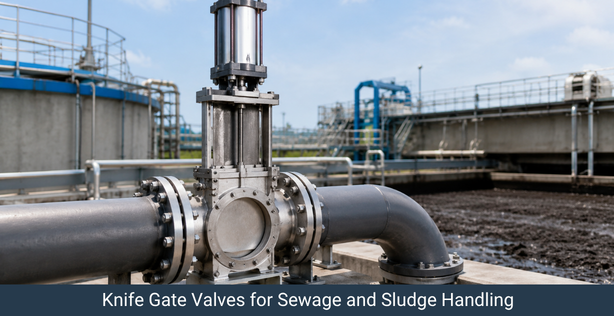
Knife Gate Valves for Sewage and Sludge Handling
Sewage and sludge lines carry heavy solids content that requires a valve capable of a clean cut through the media on every closure. Knife gate valves installed at sludge thickening, dewatering, and transfer points provide reliable isolation without the packing and clogging issues associated with other valve designs in this service.
Knife Gate Valves for Power Plants
Power generation facilities use knife gate valves in ash handling, coal slurry, and cooling water circuits. Bottom ash and fly ash lines in particular demand abrasion resistant gate and seat materials, often paired with pneumatic or hydraulic actuation for remote operation in hazardous or high temperature areas.
Our Other Product
Propeller Pumps
Knife Gate Valves for Chemical Processing
Chemical processing plants require knife gate valves constructed from corrosion resistant materials such as stainless steel, or lined with PTFE or rubber, to handle acids, caustics, and other aggressive chemicals. Seat material selection is critical in this sector, since compatibility with the specific chemical determines valve life and sealing reliability.
Knife Gate Valves for Cement and Construction Industries
Cement plants use knife gate valves to isolate and control dry bulk material flows such as raw meal, clinker dust, and cement powder, in addition to any wet slurry lines in the process. Abrasion resistant gates and dust tight seat designs are common requirements in this application.
Knife Gate Valves for Steel and Metal Processing
Steel and metal processing facilities use knife gate valves in cooling water, scale pit, and slurry handling systems associated with rolling and casting operations. High temperature and abrasive particulate content in these lines call for hardened gate materials and robust seat designs.
Knife Gate Valves for Food and Process Industries
Food and general process industries use knife gate valves for handling viscous or particulate laden fluids where hygiene and material compatibility are important considerations. Stainless steel construction with food grade seat materials is typical in this sector to meet sanitary requirements.
Knife Gate Valves for Ash and Bulk Material Handling
Ash handling and other bulk material transfer systems benefit from the knife gate valve's ability to shut off flow cleanly even with settled or compacted material present in the line. Vertical installation orientation is common in these applications to minimize material buildup on the gate when the valve is closed.
How to Select an Industrial Knife Gate Valve
- Identify the media characteristics, including solids content, abrasiveness, temperature, and chemical composition.
- Choose a body material compatible with the process fluid, cast iron and ductile iron for general duty, stainless steel or lined construction for corrosive service.
- Select a seat material matched to chemical compatibility and temperature range, such as EPDM, NBR, PTFE, or rubber lining for abrasive slurries.
- Determine whether the flow is strictly one way or can reverse, to decide between a unidirectional or bidirectional design.
- Specify the actuation method, manual, pneumatic, electric, or hydraulic, based on cycle frequency and automation requirements.
- Confirm the valve meets relevant standards such as MSS SP 81 for design and testing.
Industrial Applications and Suitable Valve Configurations
| Industry |
Typical Media |
Recommended Configuration |
| Mining and mineral processing |
Slurry, tailings |
Rubber lined, unidirectional, pneumatic or hydraulic actuation |
| Pulp and paper |
Stock, pulp slurry |
Full bore, resilient seat, manual or pneumatic |
| Wastewater treatment |
Sludge, effluent |
Ductile iron or stainless, EPDM seat |
| Power plants |
Ash slurry, cooling water |
Abrasion resistant gate, pneumatic or hydraulic |
| Chemical processing |
Acids, caustics |
Stainless steel or lined body, PTFE seat |
| Cement |
Bulk powder, slurry |
Dust tight seat, abrasion resistant gate |
| Steel and metal |
Scale water, cooling slurry |
Hardened gate, high temperature seat |
| Food and process |
Viscous or particulate fluid |
Stainless steel, food grade seat |
| Ash and bulk handling |
Dry or wet bulk solids |
Vertical installation, wear resistant seat |
Why Choose a Reliable Industrial Knife Gate Valve Manufacturer?
Selecting an experienced knife gate valve manufacturer ensures the body material, seat design, gate hardness, and actuation method are matched precisely to your industry and process conditions rather than relying on a generic, one size fits all valve. This approach reduces premature wear, unplanned downtime, and total cost of ownership across mining, wastewater, power, chemical, and other industrial applications where reliable isolation is critical to continuous operation.