
Plot No. B-3&4 Nakshtra Industrial Hub, Next to Amba Hotel, Bridge, Indore
Highway, Village Chandial, Ta : Daskroi, Dist : Ahmedabad - 382433, Gujarat, India.
Mr. Kamal Panchal
+91-9904376492 Plot No. B-3&4 Nakshtra Industrial Hub, Next to Amba Hotel, Bridge, Indore
Highway, Village Chandial, Ta : Daskroi, Dist : Ahmedabad - 382433, Gujarat, India.
Mr. Kamal Panchal
+91-9904376492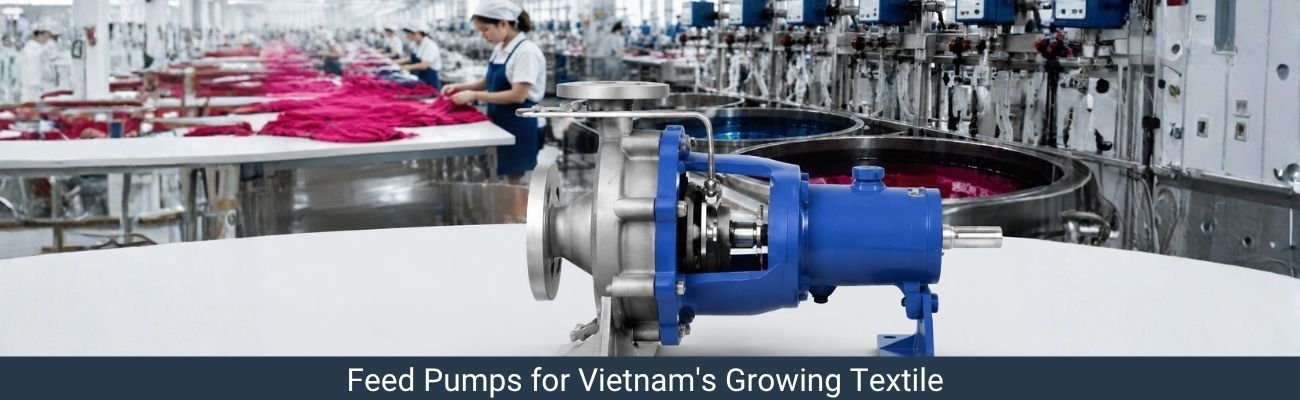
Vietnam has emerged as the world's second-largest garment and textile exporter after China, with annual export revenues exceeding USD 44 billion and a manufacturing workforce of over 3 million people. From the industrial parks of Binh Duong and Dong Nai in the south to the textile clusters of Nam Dinh, Thai Binh, and Bac Giang in the north, Vietnam's garment manufacturing complex is one of the largest and most dynamic in the world. At the heart of every textile dyeing and finishing operation - the most chemically intensive step in garment production - is the Feed Pump: a precision-engineered chemical metering device that delivers dye, auxiliary chemicals, salt, alkali, and wastewater treatment reagents with the accuracy that determines product quality, process efficiency, and environmental compliance.
Propeller Pumps India manufactures Feed Pumps, Process Pumps, Polypropylene Pumps, Centrifugal Pumps, and Chemical Process Pumps serving the precise metered-delivery, chemical transfer, and wastewater treatment requirements of Vietnam's textile and garment export factories. This article explores Vietnam's textile geography, the specific Feed Pump applications in dyeing and finishing, and the market opportunity for Indian Feed Pump Exporters.
Greater Ho Chi Minh City - including the industrial parks of Binh Duong province (Thu Dau Mot, Di An, Thuan An, Ben Cat) - hosts the largest concentration of textile and garment factories in Vietnam. The VSIP (Vietnam Singapore Industrial Park) system in Binh Duong alone houses over 800 industrial enterprises, a significant portion of which are textile and garment operations. Binh Duong's textile cluster includes major dyeing and finishing mills operated by Taiwanese, South Korean, Hong Kong, and Vietnamese investors - producing woven and knitted fabrics for the North American and European fast fashion supply chains. Each dyeing mill requires an array of Feed Pump units for reactive dye dosing, sodium hydroxide addition, acetic acid neutralization, and effluent treatment chemical dosing.
Dong Nai province - east of Ho Chi Minh City with Bien Hoa as its capital - is home to major integrated textile parks including the Long Khanh Textile Complex and the Nhon Trach industrial zones. Dong Nai's textile operations are notable for including fiber spinning, weaving, dyeing, and finishing in vertically integrated complexes, meaning that the chemical consumption - and thus Feed Pump demand - at a single facility can include sizing chemicals (starch, PVA), desizing agents (amylase enzyme), scouring chemicals (NaOH, surfactants), bleaching agents (hydrogen peroxide, sodium hypochlorite), and multiple reactive or disperse dye types. Each chemical system requires dedicated Feed Pump Manufacturers-grade metered dosing equipment.
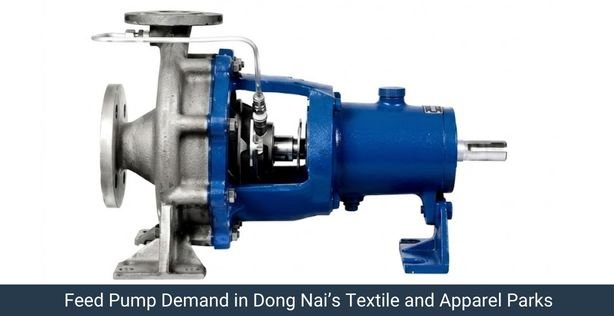
Vietnam's northern textile cluster - spanning Hanoi's satellite districts and the provinces of Bac Ninh, Hung Yen, Ha Nam, Nam Dinh, Thai Binh, and Vinh Phuc - has grown explosively as global brands diversify manufacturing away from southern Vietnam's higher labor costs. Samsung's massive electronics complex in Bac Ninh has generated a supply chain effect that draws supporting industries including packaging textiles, workwear manufacturing, and fabric production. Nam Dinh province maintains Vietnam's largest traditional textile cluster - the Nam Dinh Cotton Textile Company complex founded in the 1890s remains in operation and has been modernized with new dyeing lines requiring contemporary Feed Pump and Process Pump installations. Thai Binh is an emerging knitwear hub with dozens of new dyeing facilities requiring chemical dosing infrastructure.
Da Nang's industrial zones - including Hoa Khanh and Lien Chieu industrial parks - are developing a niche in technical textiles and synthetic fabric finishing. Technical textile dyeing - polyester disperse dyeing at 130°C under pressure, nylon acid dyeing, and functional finishing (water repellent, antimicrobial treatment) - requires Feed Pump units rated for elevated temperature and pressure service, with superior chemical resistance and precision metering accuracy. Propeller Pumps India's Feed Pump range for high-temperature disperse dyeing service includes units constructed in PVDF or SS 316L for compatibility with disperse dye carriers (xylene derivatives, dimethyl naphthalene) used in polyester dyeing.
Reactive dyes - the dominant dye class for cotton and viscose, Vietnam's most exported fabric types - bond chemically with the fiber through a reaction requiring precise pH control and chemical sequence. The Feed Pump system for reactive dyeing must deliver: reactive dye stock solution at exact volume to achieve repeatable shade; sodium chloride (salt) at up to 80 g/L concentration to promote dye exhaustion; sodium carbonate (soda ash) or sodium hydroxide at precisely calculated add-on rates to initiate the dye-fiber reaction; and leveling agents, dye fixatives, and softeners as sequential additions. Metering accuracy of ±1% or better is required for shade reproducibility - the critical quality parameter in garment fabric dyeing. Feed Pump units for reactive dye dosing in Vietnamese mills are typically rated for 10–500 L/hr flow range with variable-speed control, constructed in polypropylene for acid/alkali resistance.
Polyester fabric production is Vietnam's fastest-growing textile segment, driven by athleisure, sportswear, and technical fabric demand from global brands including Nike, Adidas, and Decathlon - all of which source significantly from Vietnamese factories. Disperse dyeing of polyester requires high-temperature jet dyeing at 130°C under 3–4 bar pressure, using disperse dye carriers that are chemically aggressive organic solvents. Feed Pump units in polyester dye kitchens must withstand continuous exposure to carrier chemicals and operate reliably at temperatures to 120°C on the hot water supply lines. Polypropylene Pumps and Chemical Process Pump variants in PVDF construction are the material standard for Vietnamese polyester dye auxiliary chemical handling.
Vietnam's Ministry of Natural Resources and Environment (MONRE) enforces QCVN 13-MT:2015/BTNMT - the national wastewater standard for textile and garment processing - which limits effluent color, COD, BOD, suspended solids, and toxic compounds before discharge to municipal sewers or water bodies. Vietnamese textile mills with dyeing operations must operate Effluent Treatment Plants (ETPs) consuming significant volumes of treatment chemicals: coagulants (polyaluminium chloride, ferric sulfate) for color and TSS removal; pH adjustment chemicals (HCl, NaOH) for pH control; flocculants (polyacrylamide) for sludge conditioning; and sodium hypochlorite for decolorization. Each chemical stream requires a dedicated Feed Pump for metered, controlled addition. Propeller Pumps India's Feed Pump Manufacturers product range includes corrosion-resistant configurations for all ETP chemical dosing duties encountered in Vietnamese textile wastewater treatment.
Before woven fabrics can be dyed, the starch or PVA sizing applied to warp yarns during weaving must be removed in the desizing process, using enzymatic (amylase) or oxidative (hydrogen peroxide) desizing systems. The sizing and desizing operations in Vietnamese weaving mills require Feed Pump units for continuous delivery of sizing agent stock, enzyme solution, oxidant, and wetting agent - all at precise concentrations to achieve consistent fabric preparation. Self Priming Pump configurations are often preferred for sizing chemical transfer from storage tanks to preparation vessels due to the high viscosity of concentrated PVA and starch sizing agents.
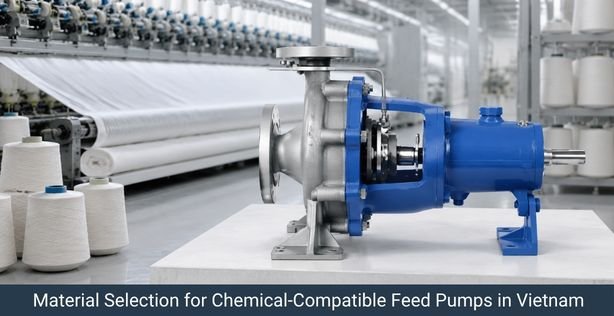
Vietnamese textile dye chemicals present a wide range of corrosion challenges. Feed Pump Manufacturers supplying Vietnam's textile industry must offer material options including: Polypropylene (PP) - the standard for reactive dye systems, sodium hydroxide, soda ash, and salt service at up to 60°C; PVDF (Polyvinylidene Fluoride) - for disperse dye carrier chemicals, acetic acid, and solvents; SS 316L stainless steel - for high-temperature disperse dye and enzyme service; and HDPE-lined construction for oxidative bleaching (H2O2, NaOCl) applications. Propeller Pumps India's Feed Pump range covers all four material options, ensuring chemical compatibility with the full range of Vietnamese textile processing chemicals.
Vietnamese textile quality managers specify Feed Pump metering accuracy of ±1% of set flow across the operating range - critical for shade consistency across production batches. Modern Vietnamese dye houses increasingly integrate Feed Pump control with batch control systems (from suppliers including Datacolor, Huntsman's ColorConnect, and locally developed Vietnamese systems), requiring Feed Pump units with 4–20 mA or digital communication interfaces compatible with PLC/SCADA integration. Propeller Pumps India's Feed Pump range supports both manual flow control and automated batch control interface configurations.
Vietnam's textile industry faces intensifying environmental regulation as international brands impose supplier sustainability requirements aligned with EU Textile Sustainability Regulation, Bluesign certification, and the Zero Discharge of Hazardous Chemicals (ZDHC) program. Brands including H&M, Inditex, and PVH Corp - major buyers from Vietnamese factories - require ETP compliance documentation and chemical management systems that depend on accurate Feed Pump dosing to demonstrate controlled chemical use and wastewater quality. Feed Pump Manufacturers supplying Vietnam's export-oriented garment sector should be able to support factory chemical management audit requirements.
 Drop Us an Email!
Vietnamese textile equipment procurement is concentrated through equipment distributors in Ho Chi Minh City (serving southern mills) and Hanoi (serving northern mills), with direct import procurement by larger group-owned mills. The Feed Pump segment in Vietnam is currently dominated by European brands (ProMinent, Grundfos, Sera) for precision chemical metering and Chinese brands for basic transfer pumps. Indian Feed Pump Exporters - including Propeller Pumps India - occupy an attractive middle ground: engineering quality and chemical resistance equal to European brands at prices 30–45% lower. The Nhava Sheva–Ho Chi Minh City shipping route offers 12–15 day transit, and India's FTA negotiations with ASEAN (ASEAN-India FTA) reduce import duties on industrial pump equipment entering Vietnam.
Vietnam's position as the world's second-largest garment exporter rests on the reliable, precise, and chemical-compatible operation of Feed Pump systems throughout the dyeing, finishing, and wastewater treatment processes that define textile product quality and environmental performance. From the reactive dye kitchens of Binh Duong to the disperse dyeing lines of Da Nang and the ETP systems of Nam Dinh's cotton mills, the Feed Pump is the critical delivery mechanism for every chemical process in the value chain. Propeller Pumps India's Feed Pump range - complemented by Polypropylene Pumps, Chemical Process Pumps, Process Pump configurations, and Self Priming Centrifugal Pump units - offers Vietnamese textile manufacturers a comprehensive, technically proven, and cost-competitive chemical handling solution from India's leading industrial pump manufacturer.